Competitors
Competitors describe General Motors Company's market in their own filings and calls. These verified passages and visual pages show where their strategies meet, using source documents preserved in Sources.
Ford Motor Company (F)
The closest competitor GM has: the same U.S. home market, the same full-size pickup and large-SUV profit pools, the same UAW cost base, the same commercial-fleet customers, and a captive finance arm alongside. Ford is one of the two rivals its own management is describing when it talks about "our two largest competitors" in Class 1–7 trucks and "our key competition" in full-size pickups. Exhibits here are confined to the North American truck, fleet and pricing discussion, where the overlap with Chevrolet Silverado / GMC Sierra, Tahoe / Suburban and GM Envolve is direct; Ford's aluminum-supply (Novelis) and Ford Energy storage commentary is left out.
An analyst asks Ford directly about "competitors out there that are sort of trying to regain share in North American trucks" — the segment where Silverado and Sierra sit against F-Series — and the head of Ford Blue answers on the record. The claims are Ford's own and unaudited: two points of revenue share and one and a half points of volume share gained in 2025, and truck leadership "expanded… over our key competitors each of the last two years." Note what is being measured — share of the full-size pickup segment, on Ford's definition, not total U.S. share, and revenue share moved more than volume share, which is a mix and transaction-price statement as much as a units one. The closing line is the operative one for GM: Ford says it intends to hold the segment by managing stock and incentive spend rather than by discounting into share.
Joseph Spak (Analyst) and Andrew Frick (President of Ford Blue and Model E): Okay. Thank you for that. And then just the second question, another one, I guess, on market factors. I wanna focus, I guess, specifically on two areas. You know, one is you've got some competitors out there that are sort of trying to regain share in North American trucks and European LCVs. So how do you think about the market impact there? […] Yeah, Joe. It's Andrew Frick. First of all, let me comment on the first part around full-size pickup. That is always a competitive segment, so this is nothing new for us. And as the leader, we have to be ready for challenges at all times. We have a great pickup lineup right now. Great F Series lineup, covering the breadth of the entire segment, and we've actually been growing. In fact, last year, as Jim mentioned, we grew two points of revenue share and one and a half points of volume share in 2025, and we've actually expanded our truck leadership position over our key competitors each of the last two years and by a sizable margin. But as we enter this year, in '26, we, of course, always approach it humbly. Our dealer network is really set up and is a real strength for us. They continue to invest in the truck business. Our stock positions are on the low end of our day supply range right now, and our overall market approach is to remain disciplined in our market equation, balancing stock share and our incentive spending.
p. 7 · Read in context →
Ford's CFO puts a three-part claim on the Q1 2026 call: for the quarter, F-150 had the highest retail share, the highest average transaction price and the lowest incentive spend per unit "versus our key competition" — the peer set that is principally Silverado, Sierra and Ram. All three are Ford's own characterisations, with no source or comparison set disclosed, and the "highest retail share" is measured on retail only, excluding fleet, where GM's mix differs. Taken at face value it is a claim to be winning volume and price simultaneously while spending less to do it; that combination, if it persists, is what compresses a competitor's pricing headroom in the segment.
Sherry House (CFO): Third, relative to U.S. inventory, we expect to remain within our target of 55 to 65 retail days supply for the year. F-Series sales remain healthy as inventory recovers from the Novelis supply disruption. America's best-selling truck delivered year-over-year retail share improvement of 30 basis points in March, and we are carrying that momentum into Q2. Our team is effectively managing tight retail day supply by helping dealers fill inventory gaps while ensuring high demand trim levels are in ample supply. We are also producing a richer mix of product as we continue to ramp Novelis. And importantly, on average, we are spending less on incentives than our competitors. In fact, for the quarter, F-150 had the highest retail share, highest average transaction price and the lowest incentive spend per unit versus our key competition.
p. 2 · Read in context →
Ford's framing of its commercial-vehicle position, from the FY2025 results call (the sentence begins on the previous page: "In the U.S., Ford Pro's class one through / seven market share is over 42%"). The comparison is the notable part — Ford states its Class 1–7 share is roughly the size of its two largest competitors combined, a set that includes GM. It is a share-of-segment claim on Ford's own definition of Class 1–7 and is not reconciled to any third-party registration data. The second half is the strategic collision rather than the share one: Ford is attaching software and physical services to the fleet relationship, reporting those at 19% of Ford Pro EBIT against a 20% target — the same recurring-revenue ground GM is contesting with GM Envolve and OnStar fleet services.
Jim Farley (President and CEO): […] seven market share is over 42%, roughly the size of our two largest competitors combined. In Europe, with the number one commercial brand, for the eleventh straight year. […] Software and physical services grew 10% and now contribute 19% for Ford Pro's EBIT, rapidly approaching our 20% target. And we continue to deepen our competitive moat. Thanks to our dealers, we're specializing in investing in more and forming new partnerships like ServiceTitan to broaden our reach and integrate directly with the trades.
p. 2 · Read in context →
Stellantis N.V. (STLA)
Stellantis is the other Detroit truck-and-SUV franchise — Ram against Silverado and Sierra, Jeep against Chevrolet and GMC utilities, and the same UAW plants and dealer network economics. Its 20-F is unusual among GM's peers in that it publishes market-share tables that name GM by automaker for both of its largest markets, the U.S. and Brazil, giving an outside-in read on GM's position in the two places GM sells most. Only the North America and South America vehicle discussion is used; the Enlarged Europe, Middle East & Africa, Maserati and Leapmotor material is out of scope.
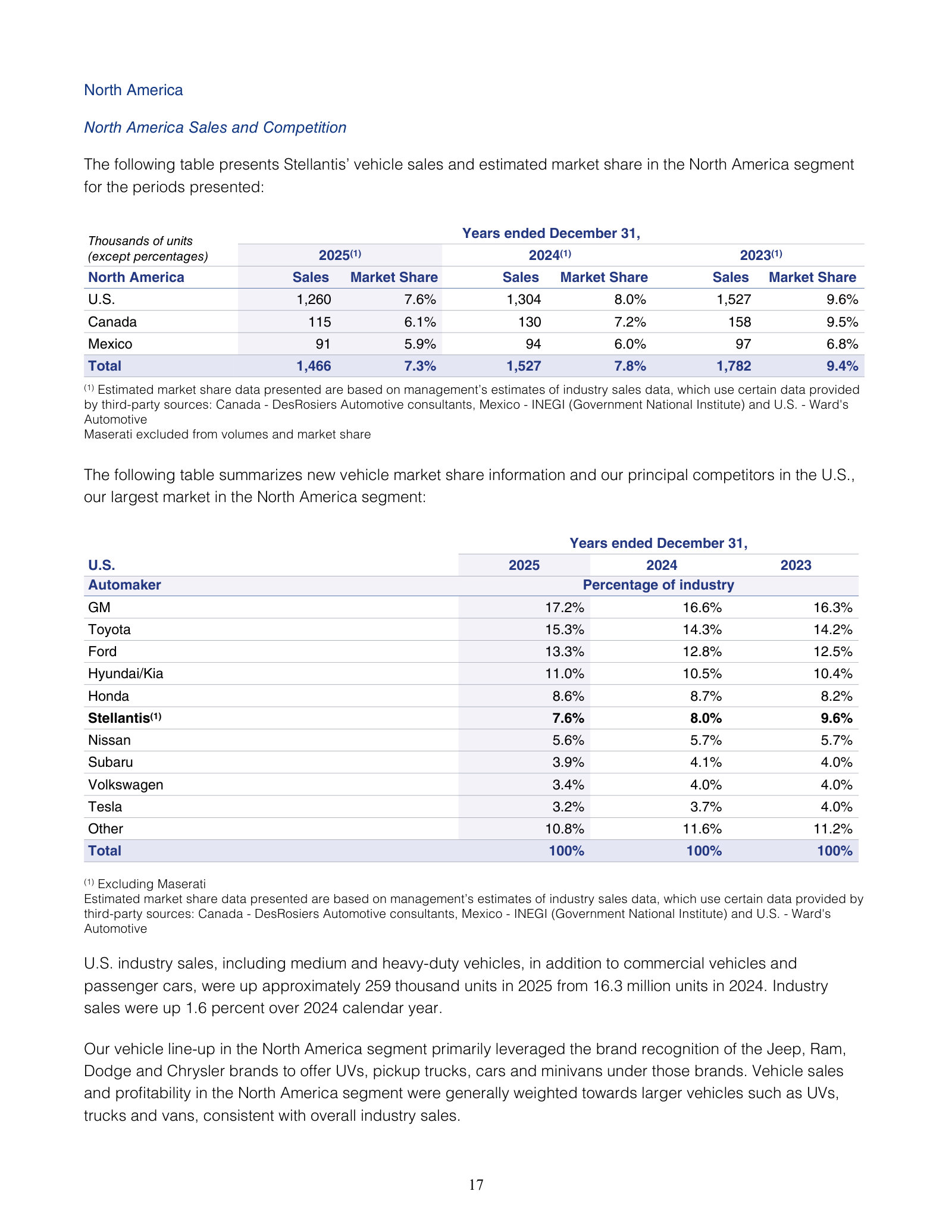
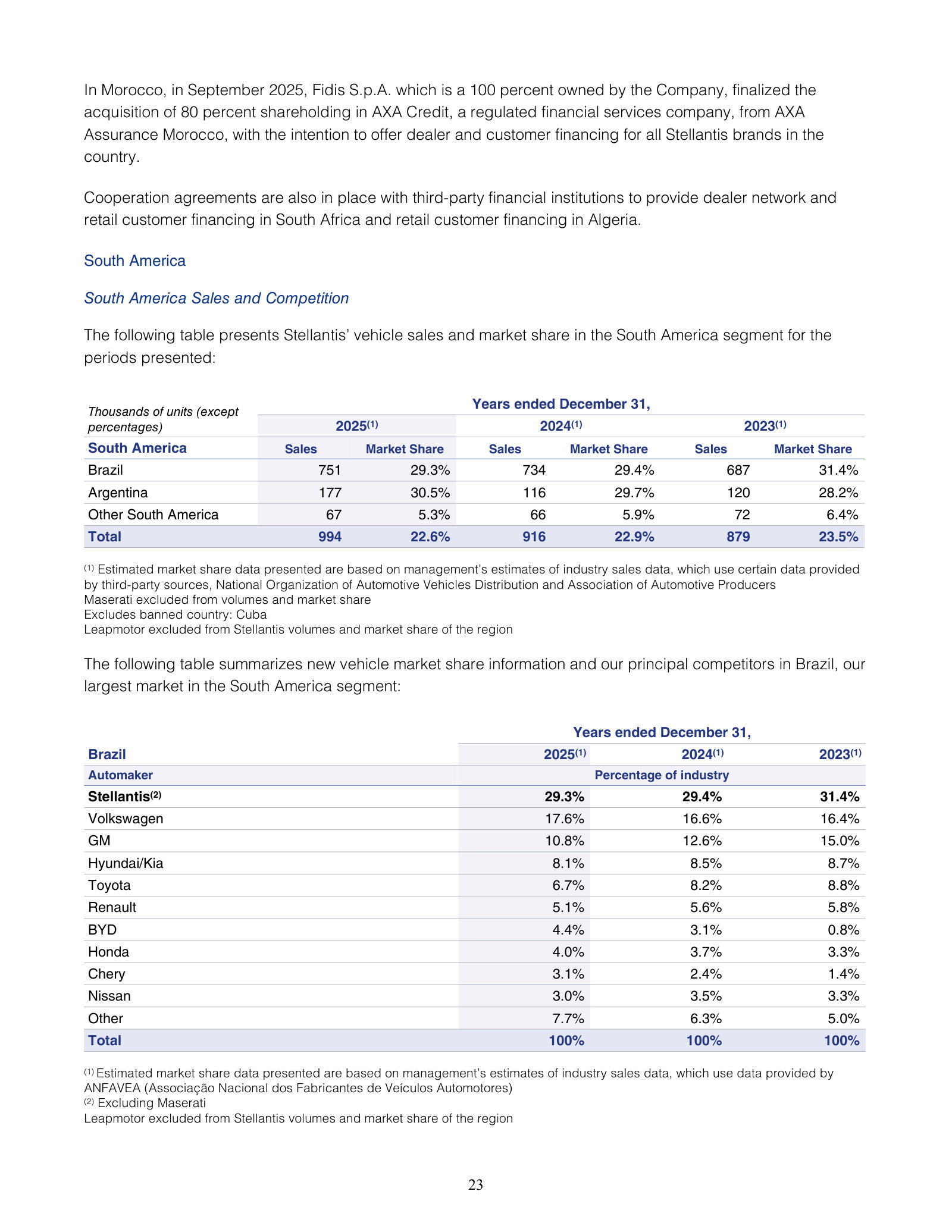
Asked what Stellantis will offer U.S. buyers below $40,000, the CEO concedes low current penetration there and commits part of a $13 billion four-year U.S. investment to the segment, plus a Ram midsize pickup for Q4 2027. Both statements point at ground GM occupies: the sub-$40,000 band where Trax, Trailblazer and Equinox are GM's volume answer, and the midsize pickup segment held by Colorado and Canyon, which has had no Ram entrant since 2011. This is a stated plan with a date, not a shipped product, and Stellantis is announcing it from a position of 7.6% U.S. share and a loss-making 2025; the relevance is that it adds a competitor to two segments rather than that it displaces anyone yet.
Antonio Filosa (Chief Executive Officer): Okay, I will start. So when we look at US and when we look at the sub $40,000 US dollar market, for sure, this is a portion of the market where our current penetration is low. And we are investing within the $13 billion investment over the next four years, also in that part of the segment. We will deliver products to be credible players, also, in the below 40k US dollar portion of the market, which is very large. I will give you an example that we already announced around additional affordability on our line-up. Well, the Ram will launch a midsize pickup truck that we will develop now, and we will launch to the market by quarter four 2027.
p. 11 · Read in context →
Tesla, Inc. (TSLA)
Tesla is the volume leader in the U.S. electric market GM has spent the most capital trying to enter, and the reference point for two of GM's stated growth vectors: affordable EVs and hands-off driver assistance sold as software. Only the automotive and FSD discussion is used here — the energy storage, Optimus, Terafab and solar-cell material is a different business and is excluded, even though it dominates the calls.
How Tesla defines its own competitive set in its FY2025 Form 10-K. Two things matter for GM. First, Tesla says it competes on traditional segment classification as well as propulsion — Cybertruck against pickup trucks, Model Y against compact SUVs — which is the same framing that puts it against Silverado EV and Equinox EV rather than only against other EVs. Second, the autonomy paragraph places Tesla's Robotaxi service in competition with ride-hailing and taxi services, and cites the Supercharger network as part of the offer. This is boilerplate 10-K competition language and names no rival; it is useful as Tesla's own statement of where it thinks the fight is, not as evidence about relative position.
Item 1. Business — Competition: The worldwide automotive market is highly competitive and we expect it will become even more competitive in the future as a significant and growing number of established and new automobile manufacturers, as well as other companies, have entered, or are reported to have plans to enter the electric vehicle market.
We believe that our vehicles compete in the market based on both their traditional segment classification as well as their propulsion technology. For example, Cybertruck competes with other pickup trucks, Model S and Model X compete primarily with premium sedans and premium SUVs and Model 3 and Model Y compete with small to medium-sized sedans and compact SUVs, all of which are extremely competitive markets. Competing products typically include internal combustion vehicles from more established automobile manufacturers; however, many established and new automobile manufacturers have entered or have announced plans to enter the market for electric and other alternative fuel vehicles. Overall, we believe these announcements and vehicle introductions promote the development of the electric vehicle market by highlighting the attractiveness of electric vehicles relative to internal combustion vehicles. Many major automobile manufacturers have electric vehicles available today in major markets including the U.S., China and Europe, and other current and prospective automobile manufacturers are also developing electric vehicles. In addition, several manufacturers offer hybrid vehicles, including plug-in versions. […] As we seek to become a top provider of autonomous solutions, we also face competition in the fields of AI and robotics. We expect our Robotaxi service to compete in this developing market, along with traditional ride-hailing and taxi services, through continued progress on our FSD (Supervised) and neural network capabilities, Supercharger network and infotainment offerings.
p. 13 · Read in context →
Tesla's read on the electric pickup segment, answering a shareholder question about whether it would build a conventional-looking truck. The claim is bounded: Cybertruck outsells other electric trucks — a segment that includes Silverado EV, Sierra EV and Hummer EV — not that it outsells pickups generally, and no volumes are given. The second sentence is the one to weigh: "Our competition continues to pull back" is Tesla's characterisation of rivals scaling back electric truck programmes, offered without specifics. GM has publicly slowed EV truck output, so the direction is consistent with the record, but the sentence is an assertion about competitors made by an interested party.
Shareholder question via say.com and Lars Moravy (VP of Vehicle Engineering): After the unveil of the Cybertruck, Elon stated tha if it didn't sell well, Tesla would build a more conventional-looking pickup. How practical would it be to create this new design on the Cybertruck architecture, and could it be conveniently built on the existing production lines?
Lars Moravy (VP of Vehicle Engineering):
Actually, in its segment, CyberTruck can be a leader and is selling more than any other electric truck out there. Our competition continues to pull back.
p. 6 · Read in context →
Toyota Motor Corporation (TM)
Toyota is the automaker closest behind GM in U.S. share — 15.3% against GM's 17.2% in 2025 on Stellantis' published estimates, and closing — and it is the company that made hybrids, rather than battery-electrics, the profitable middle path in North America. That is directly relevant to GM, which has comparatively little hybrid volume in its U.S. lineup. Only the consolidated automotive and electrification commentary is used; the Hino deconsolidation, Toyota Industries buyout and Japan governance material is set aside. Note these transcripts are third-party (Quartr via MarketBeat) captures of the results briefing and are truncated before the Q&A.
Toyota's own scorecard for the year to March 2026: 10,477,000 Toyota and Lexus vehicles, and electrified sales above 5 million units for the first time, "primarily driven by HEVs that were well-received in regions such as North America and China." The framing is Toyota's — "price revisions underpinned by strong product competitiveness" is a claim to pricing power, not a measurement of it, and operating income still fell to ¥3.8 trillion under U.S. tariffs. The volumes are the point for GM: roughly half of Toyota's global sales now carry an electrified powertrain, overwhelmingly conventional hybrids, and North America is named as a lead region for that mix.
Takanori Azuma (Accounting Group Chief Officer): Operating income for fiscal year 2026 amounted to JPY 3.8 trillion. Despite the impact of U.S. tariffs, we were able to secure profits in line with our guidance due to increased vehicle sales volumes and the effects of price revisions underpinned by strong product competitiveness as well as steadily accumulated improvement efforts, such as expanded value chain profits. […] Consolidated vehicle sales for this fiscal year reached 9,595,000 units, or 102.5% year-on-year. Toyota and Lexus vehicle sales totaled 10,477,000 units or 102.0% over the previous fiscal year. Thanks to strong demand from customers, mainly in Japan and North America, vehicle sales increased. Sales of electrified vehicles exceeded 5 million units for the first time, primarily driven by HEVs that were well-received in regions such as North America and China, while PHEVs and BEVs also posted volume growth.
p. 9 · Read in context →
Honda Motor Co., Ltd. (HMC)
Honda holds roughly 8.6% of the U.S. market and competes with GM across crossovers and mid-size pickups, but the sharper connection is strategic: Honda's two current North American EVs, the Prologue and Acura ZDX, are built by GM under the companies' platform agreement, and Honda has now written off its own North American EV programme and redirected the region to internal-combustion and hybrid volume. Only the automobile-business discussion is used; motorcycles, which carry Honda's record profits, and power products are excluded.
Honda quantifies its retreat from North American electric vehicles: cancelling the launch and development of EV models scheduled for North American production produced ¥1,310.6 billion of additional fourth-quarter losses, taking full-year EV-related losses to ¥1,577.8 billion and turning a ¥1,039.3 billion adjusted operating profit into a ¥414.3 billion reported loss. The figures are Honda's own, and the split between adjusted and reported profit is Honda's presentation. For GM the read-through is twofold — a second large manufacturer has concluded the North American EV volume it planned is not there, and the capacity and battery supply behind those cancelled models leaves the market.
Financial results briefing for FYE March 31, 2026 (May 14, 2026): In addition, as we explained on March 12, the cancellation of the launch and development of EV models that had been scheduled for production in North America resulted in additional losses of 1 trillion 310.6 billion yen in the fourth quarter.
As a result, total EV-related losses for the fiscal year ended March 2026 amounted to 1 trillion 577.8 billion yen.
Consequently, operating profit for the fiscal year ended March 2026 was a loss of 414.3 billion yen.
Excluding the 1 trillion 453.6 billion yen in EV-related losses, operating profit was 1 trillion 39.3 billion yen.
p. 2 · Read in context →
Honda's strategy slide from the February 2026 results deck, in management's own words. Three elements collide with GM. Honda states its automobile profitability rests on internal-combustion and hybrid technology, not electrification; it says it will "clear up as much of the losses possible related to EVs currently marketed in North America" — the vehicles GM builds for Honda on its platform; and it commits to next-generation hybrid systems plus next-generation ADAS fitted to hybrids, which puts advanced driver assistance into mainstream hybrid price points rather than reserving it for EVs or premium trims. The profitability claim excludes tariffs and one-time EV expenses, which is a substantial exclusion.
Management Direction in Light of Changes in the Business Environment: In automobile business, leveraging the internal combustion engine and hybrid technologies we have cultivated over many years, we have maintained a business structure capable of steadily generating profits for the nine months ended December 31, 2025, excluding the impacts of tariffs and one time EV related expenses. […] Under these circumstances, we believe our key challenge is to build a lean business structure that can respond flexibly to changes in the business environment, while achieving product and cost competitiveness that surpasses that of emerging OEMs.
To address these challenges, we aim to clear up as much of the losses possible related to EVs currently marketed in North America within the current fiscal year.
At the same time, we are exercising disciplined control over expenditures in line with the business environment, and making swift management decisions aligned with trends in the electrification market, including a review of our EV model lineup and capital expenditure plans.
Meanwhile, to further enhance the profitability of our hybrid models, we are preparing for the launch of next generation hybrid systems, as well as the introduction of next generation ADAS in hybrid models as well.
p. 20 · Read in context →
The forward plan that follows from the write-off: for the year to March 2027 Honda intends to grow North American volume by "primarily strengthen[ing] ICE/HEV sales." The accompanying unit table on page 14 of the same deck puts numbers on it — North American automobile sales guided from 1,605 thousand to 1,705 thousand units, a 100 thousand unit increase that is the largest single regional gain in the forecast. This is guidance, not a result, and it is set against a year in which Honda's North American automobile volumes fell. The competitive fact for GM is the direction: incremental Honda volume in GM's home market is planned to arrive in combustion and hybrid segments, not electric ones.
Financial Forecast for FYE March 31, 2027: Operating profit 500.0 billion yen(Adjusted operating profit excluding EV-related losses :1 trillion yen) Despite the situation in the Middle East & higher material costs, target adjusted OP in line with the previous year via Motorcycles vol. gains & efficiency (fixed-cost cuts).
Motorcycle business: By expanding production capacity in India and other measures, we plan to capture strong demand and target record-high sales of 22.8 mil. units.
Automobile business: In Asia, we will support unit sales through model updates, while in North America will primarily strengthen ICE/HEV sales to increase volumes.
p. 3 · Read in context →
More peer documents
Stellantis — Q3 2025 shipments and revenues call — Q3 FY2025 · 14 pages · Pages 4–5 lay out the $13 billion U.S. investment in full: five new vehicles, U.S. production up 50%, Ram returning to both the midsize truck and large SUV segments by 2028, and a stated 12% North American commercial-vehicle share — the plan that puts Ram back against Colorado, Tahoe and Silverado HD. · Open →
Stellantis — FY2024 Form 20-F — FY2024 · 307 pages · Pages 18 and 24 carry the prior-year versions of the same U.S. and Brazil share tables naming GM, giving a five-year run when combined with FY2025; pages 28 and 83 set out the GM v. FCA US racketeering litigation history from Stellantis' side. · Open →
Ford Motor Company — FY2025 Form 10-K — FY2025 · 180 pages · Page 9 gives Ford's sales, industry-volume and share table for nine markets (U.S. share 13.2% of a 16.7 million unit industry) plus a U.S. split of electric, hybrid and combustion sales — the cleanest peer-side sizing of the powertrain mix GM is exposed to. · Open →
Tesla — Q2 2026 earnings call — Q2 FY2026 · 12 pages · Pages 3–5 give the latest FSD and robotaxi metrics — about 55% of North American deliveries with FSD enabled at delivery, nearly 1.5 million paid customers, 380,000 unsupervised robotaxi miles across six cities — the benchmark set GM's Super Cruise and autonomy disclosures get measured against. · Open →