Annual Reports
General Motors Company's annual reports contain management's most considered account of the business. These are the sections, passages and visual pages worth opening in the originals preserved in Sources.
General Motors Company — FY2025 Annual Report (Form 10-K) — FY2025
The edition that documents the reset: $7.9 billion of EV realignment charges, $3.1 billion of tariff cost, Cruise folded into GMNA. · Open the full document →
Item 1. Business — p. 5 · Read the full section →
The whole company in a few pages: two auto segments, a captive finance arm, and the ICE-versus-EV balance GM now leans on.
Risks related to our competition and strategy — p. 24 · Read the full section →
The two risks that define GM today: EV demand that did not arrive, and profit that still rests on full-size ICE trucks and SUVs.
Slower EV adoption already cost GMNA $7.9 billion of charges in 2025, and management flags more portfolio actions if it persists.
The success of our long-term EV strategy is dependent on consumer adoption of EVs. Consumer adoption of EVs has been slower than anticipated in light of recent U.S. Government policy changes, including the termination of certain consumer tax incentives for EV purchases. […] For example, in light of the recent U.S. Government policy changes, we have reassessed our EV capacity and manufacturing footprint and completed a strategic realignment to expected consumer demand, and have recorded charges of $1.6 and $6.0 billion in the three months ended September 30, 2025 and December 31, 2025. For the year ended December 31, 2025, we recorded total charges in GMNA of $7.9 billion. If industry-wide adoption rates continue to be slow, we may need to take additional portfolio actions to better match the consumer pace of EV adoption, such as not fully utilizing or reducing the capacity of our existing or future plants or reducing production hours or shifts, and we may become subject to claims by suppliers as a result of such actions.
p. 26 · Read in context →
Management states plainly that full-size ICE trucks and SUVs carry the margin and fund everything else.
Our near-term profitability is dependent upon the success of our current line of vehicles, particularly our full-size ICE SUVs and full-size ICE pickup trucks. While we offer a broad portfolio of cars, crossovers, SUVs, and trucks, along with a strategic portfolio of EVs, we currently recognize the highest profit margins on our full-size ICE SUVs and full-size ICE pickup trucks. As a result, our success is dependent upon our ability to sell higher margin vehicles in sufficient volumes. We are also using the cash generated by our current ICE vehicles to fund our growth strategy, including with respect to the continued development of next-generation ICE vehicles, EVs, autonomous and ADAS technologies, and software-enabled services. […] More stringent fuel economy regulations could also impact our ability to sell these vehicles or could result in additional costs associated with these vehicles, which could be material.
p. 26 · Read in context →
Risks related to our operations — p. 29 · Read the full section →
Tariffs and China moved GM’s 2025 numbers more than anything else, and both risks are written with figures rather than boilerplate.
GM concedes its mitigation actions will not fully offset tariffs in the near term.
Tariffs applicable to the automotive industry continue to evolve, including in the U.S., where the government has signaled tariff policy may shift in the future. Such tariffs could have a material adverse effect on our financial condition and results of operations. […] We cannot predict with complete precision the breadth of tariffs and related costs that will impact GM in the future. As a result, the ultimate impact of tariffs on our business could exceed our current estimates, which could have a material adverse effect on our financial condition, results of operations and cash flows, and our expected financial results. Our efforts to mitigate the impact of tariffs, including, but not limited to, making changes to our U.S. production plan and reducing or pausing certain imports, may not be successful, and we do not expect such actions to fully offset the impact of tariffs in the near term.
p. 31 · Read in context →
The China JV write-downs quantified, with more SGM restructuring charges expected in 2026.
Our business in China subjects us to unique operational, competitive, regulatory, and economic risks. […] Over the last several years, this intense competition and an increasingly challenging operating environment negatively impacted the profitability of our operations in China, our China JVs' ability to grow vehicle sales in China, and our ability to generate sustainable equity income from our China JVs. As a result of certain restructuring actions previously announced in December 2024, we recorded an other-than-temporary impairment of our equity interests of $2.1 billion and additional equity losses of $2.0 billion in the year ended December 31, 2024, and we recorded charges of $0.6 billion in the year ended December 31, 2025. We expect SAIC General Motors Corp., Ltd. (SGM) will likely incur additional restructuring charges in 2026.
p. 31 · Read in context →
Item 7. Management's Discussion and Analysis of Financial Condition and Results of Operations — p. 51 · Read the full section →
The Overview sizes the year’s two shocks — tariffs and the EV realignment — then sets 2026 guidance against them.
Tariffs cost $3.1 billion of EBIT-adjusted in 2025, with $3.0-4.0 billion guided for 2026.
Over the course of 2025, the U.S. and other governments implemented new tariffs relevant to GM and its suppliers, including tariffs on vehicles and parts imported into the U.S. […] In 2025, impacts to earnings before interest and taxes (EBIT)-adjusted from tariffs were $3.1 billion. Based on the current tariff environment, we estimate that impacts to EBIT-adjusted could range from $3.0 billion to $4.0 billion for the year ending December 31, 2026. […] Because of these recent U.S. Government policy changes, including the termination of consumer tax incentives for EV purchases and the reduction in stringency of emissions regulations, industry-wide consumer demand for EVs in North America began to slow in 2025.
p. 51 · Read in context →
Automotive Financing - GM Financial Summary and Outlook — p. 55 · Read the full section →
Almost half of GM Financial’s revenue is lease income, which makes used-vehicle residual values a direct GM earnings exposure.
Penetration, revenue mix and the residual-value exposure that sits behind 46% of GM Financial revenue.
GM Financial's penetration of our retail sales in the U.S. was 33% in the year ended December 31, 2025 and 39% in the corresponding period in 2024. […] In the year ended December 31, 2025, GM Financial's revenue consisted of leased vehicle income of 46%, retail finance charge income of 41%, and commercial finance charge income of 7%. […] Through its leasing program GM Financial is exposed to residual values, which are heavily dependent on used vehicle prices. Gains on terminations of leased vehicles of $0.6 billion and $0.8 billion were included in GM Financial interest, operating, and other expenses in the years ended December 31, 2025 and 2024.
p. 55 · Read in context →
Consolidated Results — p. 55 · Read the full section →
The passage that reconciles the $8.1 billion cost increase to its causes — EV realignment, tariffs, warranty — line by line.
Management's own bridge for the year's cost increase, from the EV realignment down to Cruise wind-down savings.
In the year ended December 31, 2025, increased Cost was primarily due to: (1) charges of $7.7 billion due to our EV strategic realignment; (2) increased material and freight costs of $3.3 billion, including $3.1 billion due to tariffs; (3) increased warranty-related costs and campaigns of $1.3 billion; (4) unfavorable net realizable value inventory adjustments, primarily EV-related, of $0.3 billion in the year ended December 31, 2025 compared to similar favorable inventory adjustments of $0.5 billion in the year ended December 31, 2024; (5) charges of $0.5 billion due to legal matters for our former OnStar Smart Driver program; and (6) increased manufacturing costs of $0.5 billion; partially offset by (7) the reduction of charges related to Cruise restructuring of $1.1 billion; and (8) decreased engineering costs of $0.9 billion, driven primarily by the wind down of Cruise robotaxi operations.
p. 56 · Read in context →
GM North America — p. 57 · Read the full section →
GMNA is 83% of revenue; here are the volume/mix/price/cost bridge and the truck-versus-car variable-profit spread.
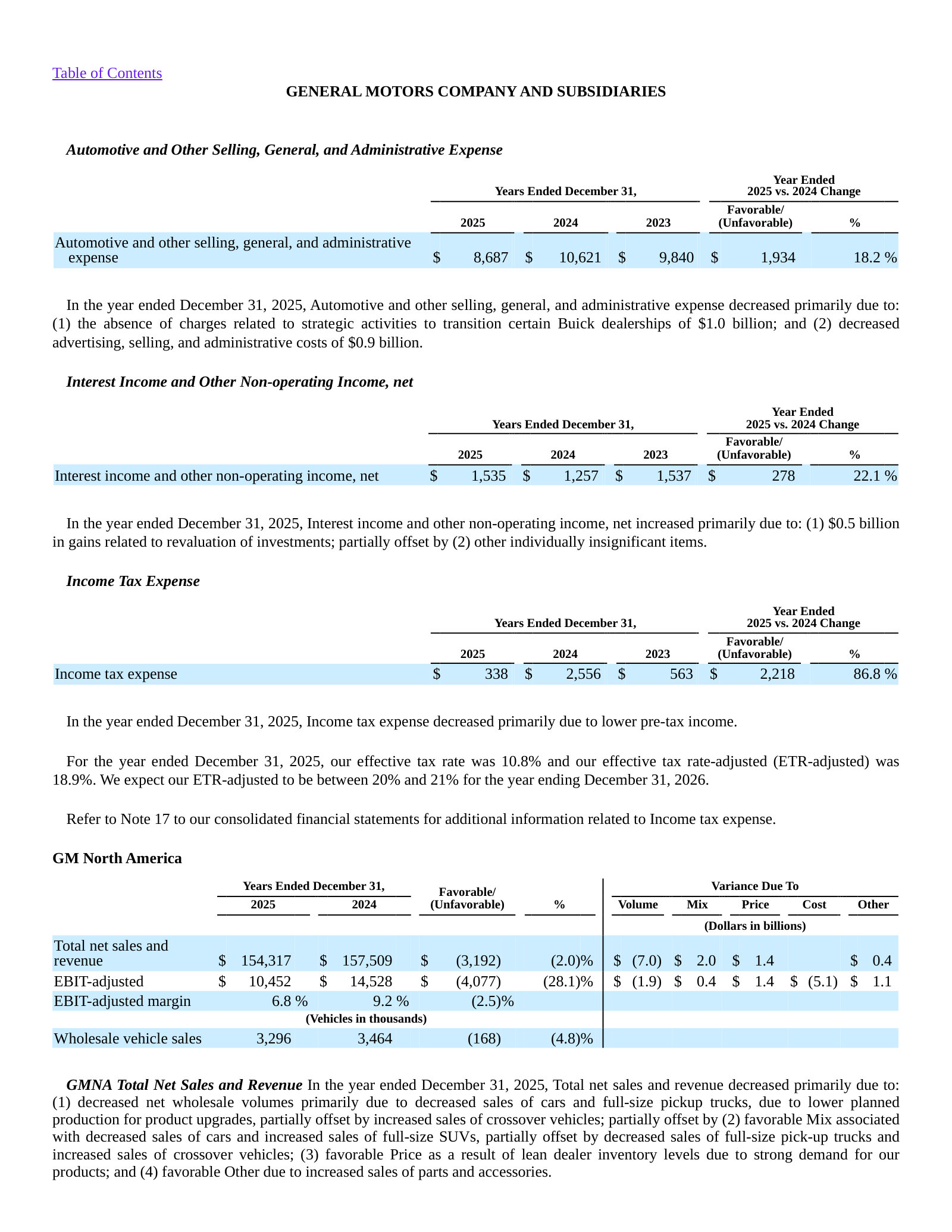
The variable-profit spread — trucks at ~160% of portfolio average, crossovers at ~40% — that makes mix decisive.
GMNA EBIT-Adjusted The most significant factors that influence profitability are industry volume and market share. While not as significant as industry volume and market share, another factor affecting profitability is the relative mix of vehicles sold. Trucks, crossovers, and cars sold currently have a variable profit of approximately 160%, 40%, and 60% of our GMNA portfolio on a weightedaverage basis.
p. 59 · Read in context →
Critical Accounting Estimates — p. 69 · Read the full section →
Warranty/recall accruals and sales incentives set GM’s reported revenue and cost, and both carry disclosed sensitivities.
Incentives are booked as a revenue reduction at the time of sale on estimated take-up, not on cash paid.
Sales Incentives The estimated effect of sales incentives offered to dealers and end customers is recorded as a reduction of Automotive net sales and revenue at the time of sale. […] Significant factors used in estimating the cost of incentives include type of program, forecasted sales volume, product mix, and the rate of customer acceptance of incentive programs, all of which are estimated based on historical experience and assumptions concerning future customer behavior and market conditions. A change in any of these factors affecting the estimate could have a significant effect on recorded sales incentives. A 10% increase in the cost of incentives would increase the sales incentive liability by approximately $0.3 billion.
p. 69 · Read in context →
General Motors Company — FY2022 Annual Report (Form 10-K) — FY2022
Included for the strategy contrast: peak EV and Cruise ambition, stated in the same sections FY2025 now uses to walk it back. · Open the full document →
Item 1. Business — p. 5 · Read the full section →
Read against FY2025, this is the commitment GM later unwound — EV capacity targets and a dedicated Ultium platform.
The 2022 target: one million EVs of North American capacity and more than two million globally by the end of 2025.
Our vision for the future is a world with zero crashes, zero emissions and zero congestion, which guides our growth-focused strategy to invest in electric vehicles (EVs) and autonomous vehicles (AVs), software-enabled services and subscriptions and new business opportunities, while strengthening our market position in profitable internal combustion engine (ICE) vehicles, such as trucks and sport utility vehicles (SUVs). […] Electric Vehicles We plan to rapidly scale our capacity to build one million EVs in North America and more than two million EVs globally by the end of 2025. A key element in our EV strategy is Ultium, our dedicated electric vehicle propulsion architecture.
p. 5 · Read in context →
Environmental and Regulatory Matters — p. 19 · Read the full section →
The explicit all-electric pledge that the FY2025 filing replaces with a portfolio hedged between ICE and EVs.
The 2035 tailpipe-emissions pledge, stated as company policy three years before the EV capacity realignment.
We plan to be carbon neutral by 2040 in our global products and operations, supported by a commitment to science-based targets. In addition, the Company envisions an all-electric future and plans to eliminate tailpipe emissions from new U.S. light-duty vehicles by 2035.
p. 23 · Read in context →
More annual reports
General Motors Company — FY2024 Annual Report (Form 10-K) — FY2024 · 180 pages · The last edition before the EV realignment; records the $4.0 billion China JV charges and the decision to stop funding Cruise robotaxis. · Open →
General Motors Company — FY2023 Annual Report (Form 10-K) — FY2023 · 181 pages · Covers the UAW strike year and the Cruise operational pause, with Cruise still reported as a separate segment. · Open →
General Motors Company — FY2021 Annual Report (Form 10-K) — FY2021 · 166 pages · The semiconductor-shortage year, and the filing that first commits to "an all-electric future" and more than $35.0 billion of EV/AV spend. · Open →